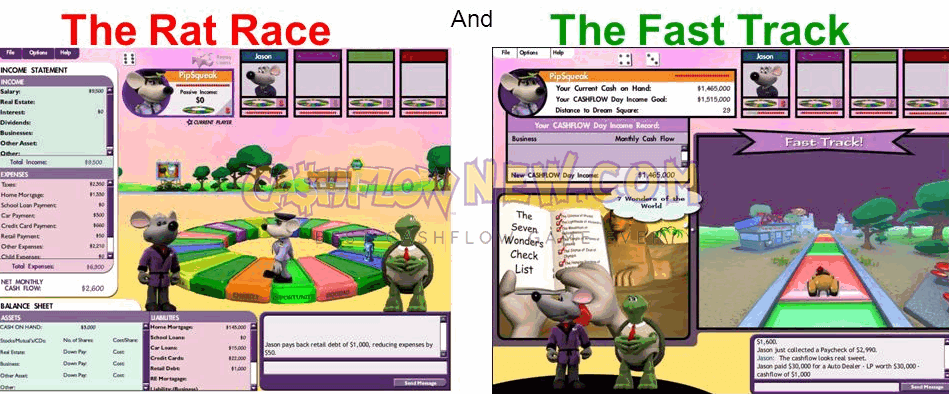
In this walkthrough we play CASHFLOW as the Teacher. In this game the Teacher starts with a salary of about $3,300 a month and roughly $1,100 left over after expenses each Paycheck. That doesn’t sound like much, but the Teacher is one of the professions that can escape the Rat Race fastest. Watch the game, then read the strategy breakdown below.
Why low expenses are a hidden advantage
To leave the Rat Race in CASHFLOW 101, passive income must be greater than total expenses. The Teacher’s expenses are only around $2,200 a month, so a handful of small rental properties can be enough. Compare that with the Doctor, who needs more than four times as much passive income. Many experienced players say that having low expenses is the biggest lesson the game teaches.
The strategy used in this game
1. Start with Small Deals
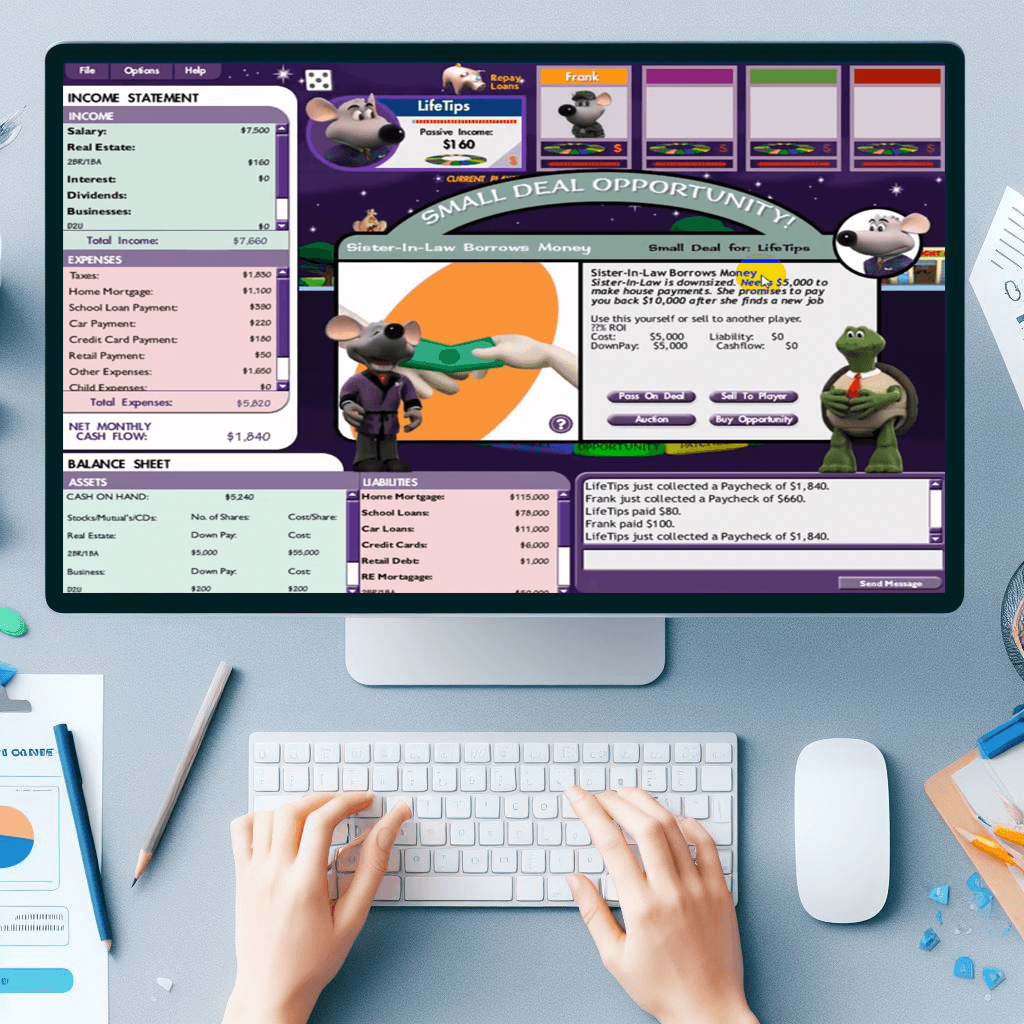
With about $1,100 per Paycheck, the Teacher can rarely afford Big Deals early. Instead, every Opportunity space was used for a Small Deal: starter houses and condos with low down payments and positive monthly cash flow. Each one added $100 to $200 a month of passive income.
2. Buy low, sell high
The turning point came from Market cards. Properties bought cheaply were sold to Market buyers at a strong premium. Those lump sums turned a small cash balance into enough money for larger deals.
3. Trade up to bigger cash flow
Instead of spending the profits, the Teacher reinvested them into properties with more units and higher rent. Passive income grew faster with each cycle, until rental income was well above total expenses.
4. Say no to Doodads on credit
On a small salary, one new credit card payment can wipe out the cash flow from a rental. Paying Doodads in cash kept the escape target low.
Escaping and the Fast Track
After the escape, the Teacher’s Fast Track income started at 100 times the passive income at that moment. From there, the goal was to buy Fast Track businesses toward the $50,000 monthly cash flow target, or land on and buy the chosen Dream.
Lessons for low-salary professions
- Your expenses set your finish line. Keep them low and you need fewer assets to be free.
- Small deals add up. Five properties at $200 a month equals $1,000 of passive income.
- Use capital gains as fuel. Flip a deal only when the profit buys more cash flow.
- Patience wins. A slow, steady build of assets beats risky bets on a small salary.
FAQ
Is the Teacher a good profession in CASHFLOW?
Yes. The Teacher has a small salary but low expenses, so the passive income needed to escape the Rat Race is modest. Steady Small Deal investing often gets the Teacher out quickly.
How much passive income does the Teacher need to escape?
Passive income must be greater than total monthly expenses. For the Teacher that is roughly $2,200 at the start of the game, but having children or taking loans raises the target.
Should a low-income player borrow from the bank?
Only when a deal’s cash flow clearly covers the loan interest. Bank loans add 10% of the borrowed amount to monthly expenses, which raises your escape target.
Play CASHFLOW 101 & 202 on your PC
Get the Windows e-game edition with a step-by-step installation tutorial and video lessons, so you can practice these strategies tonight.
See the opposite approach in our Doctor walkthrough.