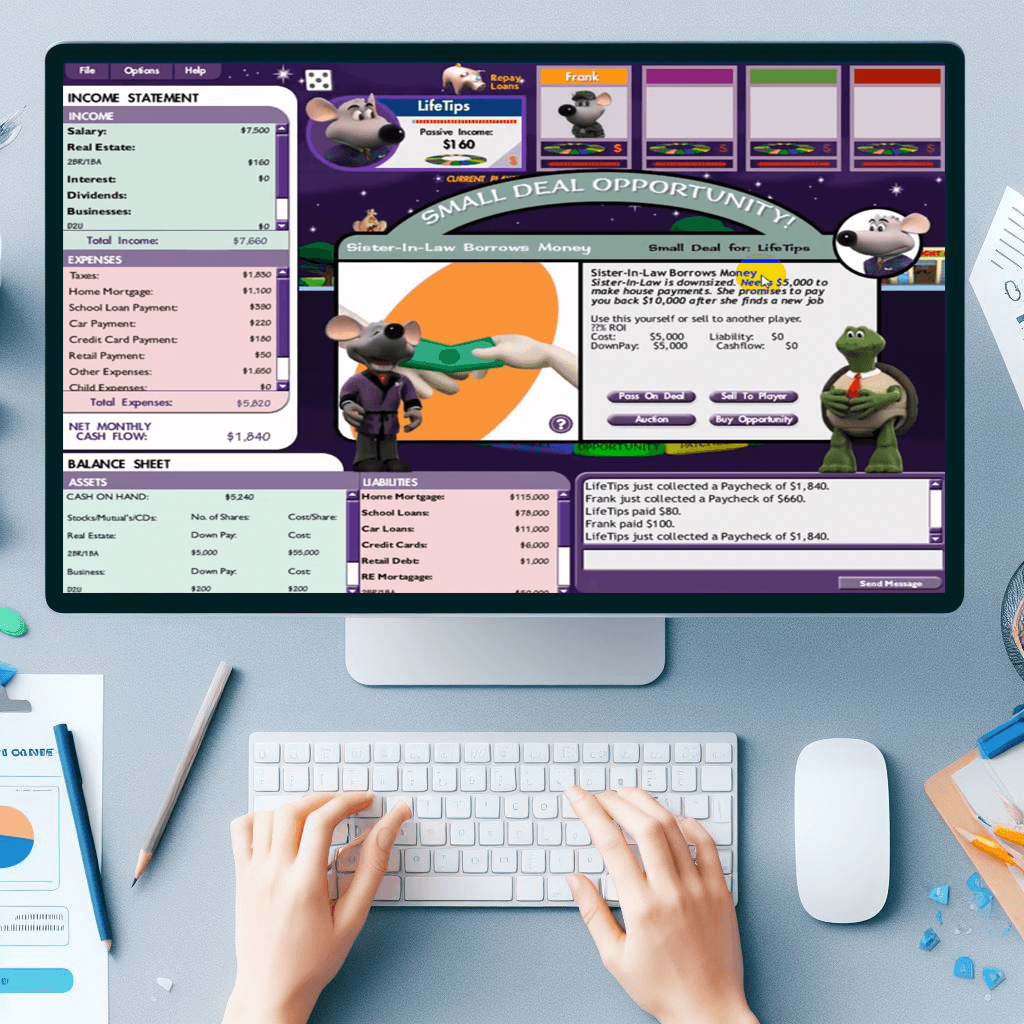
The CASHFLOW e-game is the computer version of Robert Kiyosaki’s board game. It follows the same rules, but the computer acts as banker and auditor, so you can play a full game alone in about an hour and spend your energy on decisions instead of bookkeeping. This guide walks through each part of the screen and gives you a simple plan for your first game.
Step 1: Start a new game
The opening screens set up your game. The numbers below match the labels in the screenshot.

- Game mode (①). Choose single-player to play against computer opponents. This is the best way to learn because you can pause and think.
- Version (②). Pick CASHFLOW 101 for your first games. Switch to 202 once you can reliably escape the Rat Race in 101.
- Your Dream (③). The Dream is one of your two ways to win on the Fast Track. Pick one you can afford quickly, rather than the most expensive one.
- Player name (④). Enter any name. Your profession is then dealt at random.
Step 2: Read your financial statement
The financial statement is the heart of CASHFLOW. Everything you do in the game changes one of its four parts.
Income statement (⑤)
Your income has two sources. Earned income is your salary. Passive income comes from assets: rent, dividends and business profits. Only passive income counts toward escaping the Rat Race, so watch that line most closely.
Expenses (⑥)
Expenses include taxes, home mortgage, school loans, car and credit card payments, other expenses, any child costs and bank loan interest. Lower expenses make the escape target smaller, which is why paying off a high-payment liability can be as useful as buying a new asset.
Assets (⑦)
In CASHFLOW an asset is anything that puts money in your pocket each month: rental houses, apartment buildings, businesses and dividend-paying stocks. Growth stocks and land are also assets, but they make money when you sell, not monthly.
Liabilities (⑧)
Liabilities are what you owe: your home mortgage, car loan, credit cards, school loans, property mortgages and bank loans. Mortgages on income properties are “good debt” when the property’s rent covers the payment and leaves positive cash flow.
Step 3: Understand the board
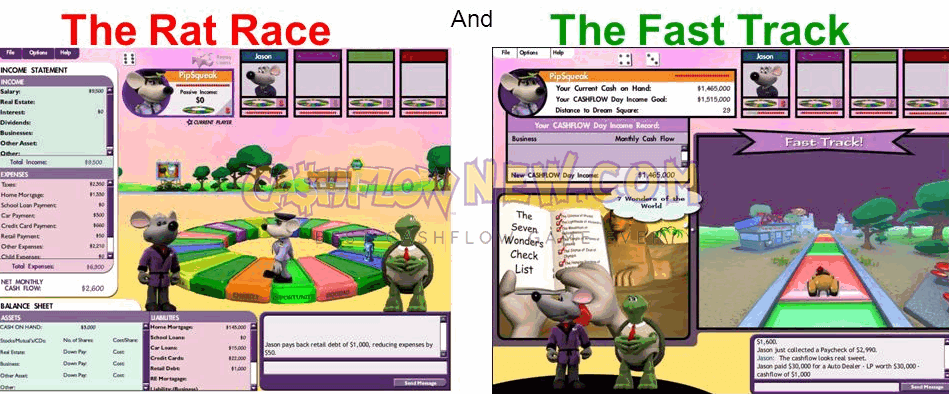
The inner circle is the Rat Race, where everyone starts. The outer circle is the Fast Track, where you play with much bigger deals once your passive income is greater than your expenses. The colored spaces on the Rat Race are:
- Paycheck: you collect your monthly cash flow (total income minus total expenses) each time you pass or land here.
- Opportunity: draw a Small Deal (up to $5,000 down) or a Big Deal ($6,000 and up) in 101, or a Capital Gain or Cash Flow deal in 202.
- Market: buyers appear for specific assets. This is where you sell property, stocks or businesses at a profit.
- Doodads: unexpected spending you must pay, such as a new gadget or a dinner out.
- Charity: give 10% of your total income to roll two dice for your next three turns.
- Baby: adds a monthly child expense (maximum three children).
- Downsized: pay one month of total expenses and lose two turns.
Step 4: A simple plan for your first game
- Keep enough cash for a Small Deal. Early on, $2,000 to $5,000 in cash lets you take most Small Deal real estate and cheap stock offers.
- Buy positive cash flow first. Houses and small businesses that add $100 to $300 per month move you steadily toward the exit.
- Buy cheap stock and sell high. Stocks bought at $1 to $5 and sold at $25 or more on a later card can fund a Big Deal.
- Take Charity when you can. Two dice means more Paychecks and more Opportunities.
- Use bank loans carefully. Loans come in $1,000 units and add 10% of the amount to your monthly expenses. Borrow only for deals whose cash flow covers the interest.
Common beginner mistakes on PC
- Clicking through Opportunity cards without checking the cash flow line. Always ask “what does this add per month?”
- Selling a cash-flowing property on the Market for a small profit. Unless the cash funds a bigger deal, you are moving backwards.
- Ignoring other players’ cards. Some Market cards let every player who owns the asset sell, so stay alert on their turns.
FAQ
Can I play CASHFLOW on PC alone?
Yes. The e-game’s single-player mode lets you play against computer opponents, so you can practice whenever you like.
Should I start with CASHFLOW 101 or 202?
Start with 101. CASHFLOW 202 uses the same board but adds volatility and requires passive income of at least twice your expenses to escape, so it is much harder without solid 101 experience.
How long does a game take on PC?
A single-player game of 101 usually takes 45 to 90 minutes. Games of 202, and games with more players, take longer.
Play CASHFLOW 101 & 202 on your PC
Get the Windows e-game edition with a step-by-step installation tutorial and video lessons, so you can practice these strategies tonight.
Next: read the complete CASHFLOW 101 & 202 rules.