Why Robert Kiyosaki created CASHFLOW
Kiyosaki’s message in Rich Dad Poor Dad is that schools teach people to work for money but rarely teach how money works. He contrasts his “poor dad,” a highly educated employee who struggled financially, with his “rich dad,” a business owner who taught him to buy assets. Kiyosaki believed people learn best by doing, so he designed a game that lets players practice financial decisions without real risk.
1996: the original board game
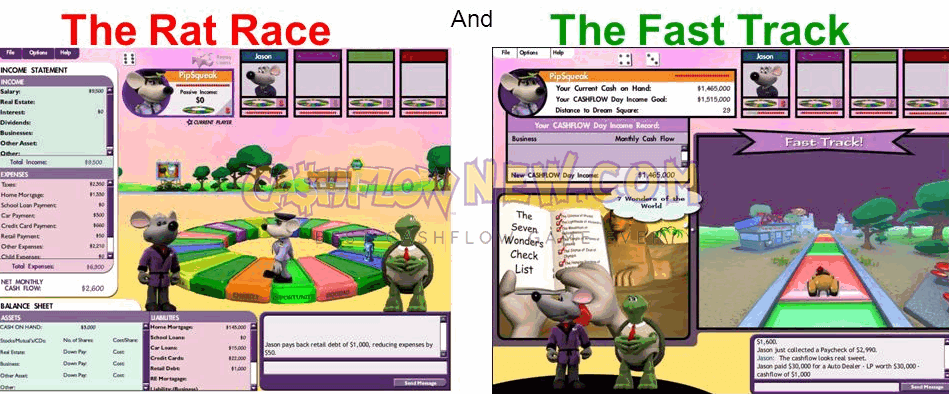
CASHFLOW (later called CASHFLOW 101) was first released in 1996. Players draw a profession card, fill in a financial statement, and move around the “Rat Race.” The goal is to buy assets, such as real estate, stocks and businesses, until passive income is greater than total expenses. Players then move to the outer “Fast Track,” where they race to buy their Dream or build $50,000 of monthly cash flow.
The game’s most distinctive feature was the financial statement itself. Instead of just counting money, players track income, expenses, assets and liabilities, which is the same structure accountants and investors use.
New editions: CASHFLOW for Kids and CASHFLOW 202
CASHFLOW for Kids brought the same ideas to younger players with simpler rules and no heavy math. CASHFLOW 202 was created as an advanced add-on to 101. It uses the 101 board but adds market volatility and technical investing ideas such as short selling and options. In the e-game version of 202, players need passive income of at least twice their expenses to escape the Rat Race.
The e-game era
Kiyosaki also released computer versions of CASHFLOW 101 and 202, known as CASHFLOW: The E-Game. The computer handles the banking and auditing, so a full game can be played solo in about an hour. The built-in auditor will not let you place an item on the wrong line of your statement, which makes the e-game an excellent teacher for beginners.
CASHFLOW clubs around the world
As Rich Dad Poor Dad became a global bestseller, players started forming CASHFLOW clubs that meet regularly to play and discuss investing. These clubs helped the game spread to many countries and languages, and many players say their first real investment came after a club game.
Why CASHFLOW is still popular today
- It teaches a durable framework. Assets, liabilities, income and expenses never go out of date.
- It rewards skill over luck. Dice matter, but good decisions matter more over many games.
- It makes money social. Playing with others opens conversations most people avoid.
- It works for all ages. From CASHFLOW for Kids to CASHFLOW 202, there is a version for every level.
FAQ
Who invented the CASHFLOW game?
CASHFLOW was designed by Robert Kiyosaki, the author of Rich Dad Poor Dad.
When was CASHFLOW released?
The original CASHFLOW board game, now known as CASHFLOW 101, was first released in 1996.
What is the difference between CASHFLOW 101 and 202?
CASHFLOW 101 teaches the fundamentals of getting out of the Rat Race. CASHFLOW 202 is an advanced version that uses the same board but adds volatility and techniques such as short selling and options.
Play CASHFLOW 101 & 202 on your PC
Get the Windows e-game edition with a step-by-step installation tutorial and video lessons, so you can practice these strategies tonight.