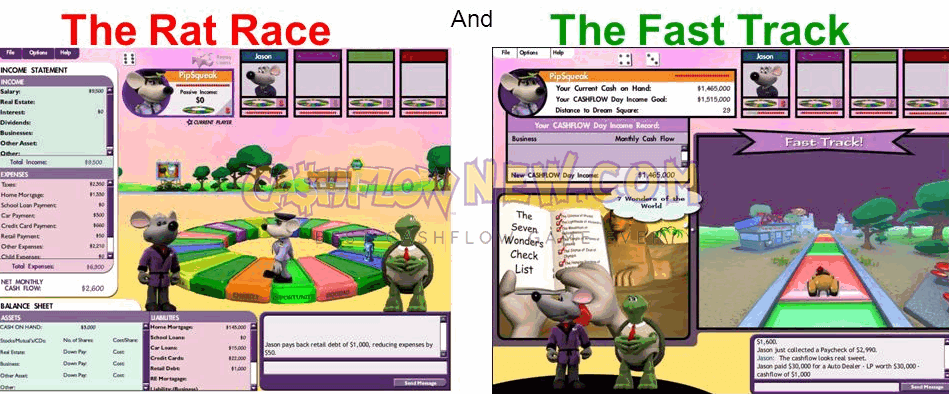
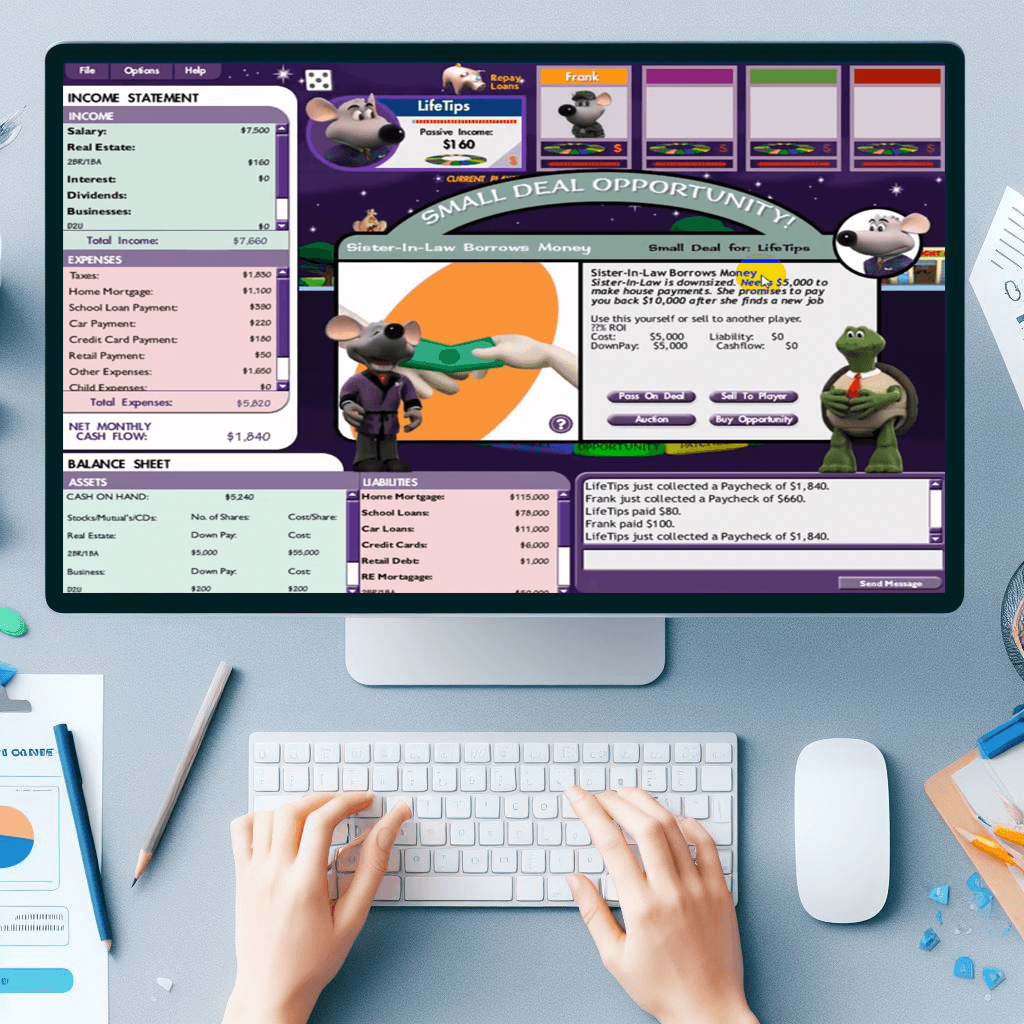
If you are new to Robert Kiyosaki’s CASHFLOW games, the “101” and “202” labels can be confusing. They are not two unrelated games, and 202 is not simply a newer edition. This guide explains exactly how they differ and how to decide which one to play.
The short version
| CASHFLOW 101 | CASHFLOW 202 | |
|---|---|---|
| Level | Beginner to intermediate | Advanced |
| Main lesson | Fundamental investing: buy assets that produce cash flow | Technical investing: profit from market moves up and down |
| Board | Own board | Uses the 101 board (board game) or the same e-game |
| Opportunity cards | Small Deals and Big Deals | Capital Gain Deals and Cash Flow Deals |
| Escape condition (e-game) | Passive income > total expenses | Passive income ≥ 2 × total expenses |
| Winning (e-game) | Buy your Dream or add $50,000 Fast Track cash flow | Add $50,000 Fast Track cash flow and buy your Dream or any two Dreams |
| Typical length | 1–3 hours (board), under an hour solo on PC | Noticeably longer |
What CASHFLOW 101 teaches
CASHFLOW 101 is built around one idea: you become financially free when your passive income exceeds your expenses. You learn to read an income statement and balance sheet, to tell assets from liabilities, and to judge deals by the monthly cash flow they add. The investments are mostly straightforward: rental houses and apartment buildings, small businesses, and stocks you buy low and sell high.
Kiyosaki describes 101 and CASHFLOW for Kids as teaching fundamental investing: buying solid assets for the income they produce.
What CASHFLOW 202 adds
CASHFLOW 202 teaches technical investing: making money from price movements, including falling markets. The main additions are:
- Volatility. Markets swing more, so timing matters and assets can lose value quickly.
- Short selling. You can profit when a stock price falls.
- Options. Calls and puts let you control or protect positions for a smaller amount of cash.
- Different deal types. Opportunities are split into Capital Gain Deals, which mainly generate cash, and Cash Flow Deals, which add passive income. Both include businesses, real estate and paper assets.
- Tougher Doodads. Some Doodads are larger and add monthly maintenance costs.
- A higher bar. In the 202 e-game you need passive income of at least twice your expenses to leave the Rat Race. For a Truck Driver with $1,620 in expenses, that means $3,240 or more.
Do you need 101 to play 202?
For the board game, yes. CASHFLOW 202 is sold as an advanced supplement with new cards and game sheets, and it is played on the CASHFLOW 101 board with 101’s pieces. On PC, the e-game lets you choose 101 or 202 from the start menu.
Which should you play first?
Start with 101. The financial statement and the logic of cash flow are the foundation of everything in 202. A good rule of thumb is to move up once you can escape the Rat Race in 101 in most games and understand why your winning games worked.
Play 101 if you…
- are new to investing or to the game
- want to teach a group of beginners
- are playing with teenagers
- have one to two hours for a board game
Play 202 if you…
- escape the Rat Race in 101 regularly
- want to understand short selling and options in a safe setting
- enjoy higher risk and more decisions per turn
- have a longer block of time
How to transition from 101 to 202
- Learn the new vocabulary first. Make sure everyone understands what shorting a stock and buying a call or put option mean.
- Play one practice game solo on PC. The e-game handles the extra calculations so you can focus on decisions.
- Expect to lose cash early. Volatility punishes overconfident trades. Size positions so one bad move does not bankrupt you.
- Keep your 101 habits. Low expenses and steady cash flow still matter; 202 just adds more tools.
Are you ready for CASHFLOW 202? A quick self-test
Answer these five questions honestly before your first 202 game:
- Can you fill in and update the financial statement without help?
- Have you escaped the Rat Race in at least three of your last five 101 games?
- Can you explain why selling a cash-flowing property might set you back?
- Do you know what it means to short a stock?
- Can you explain the difference between a call option and a put option in one sentence each?
If you answered yes to four or five, you are ready. If you answered yes to two or three, play a few more 101 games and read our guide to short selling and options first. If you answered yes to one or none, focus on 101 for now; the lessons there are the foundation for everything in 202.
A mixed-level game night idea
Groups with both beginners and experienced players can run two tables: 101 for newer players and 202 for veterans. Meet in the middle for the debrief. Beginners hear what the advanced game teaches, and experienced players revisit the fundamentals by explaining them. It is one of the easiest ways to keep a group growing without anyone feeling left behind.
FAQ
Is CASHFLOW 202 harder than 101?
Yes. It adds volatility, bigger expenses and advanced techniques, and in the e-game you need passive income of at least twice your expenses to escape the Rat Race.
Can you play CASHFLOW 202 without 101?
Not as a board game. CASHFLOW 202 uses the CASHFLOW 101 board and pieces. The e-game includes both versions.
Which CASHFLOW game is best for beginners?
CASHFLOW 101. Younger players can start with CASHFLOW for Kids.
Play CASHFLOW 101 & 202 on your PC
Get the Windows e-game edition with a step-by-step installation tutorial and video lessons, so you can practice these strategies tonight.
Related: full 101 & 202 rules · 9 strategies to escape the Rat Race