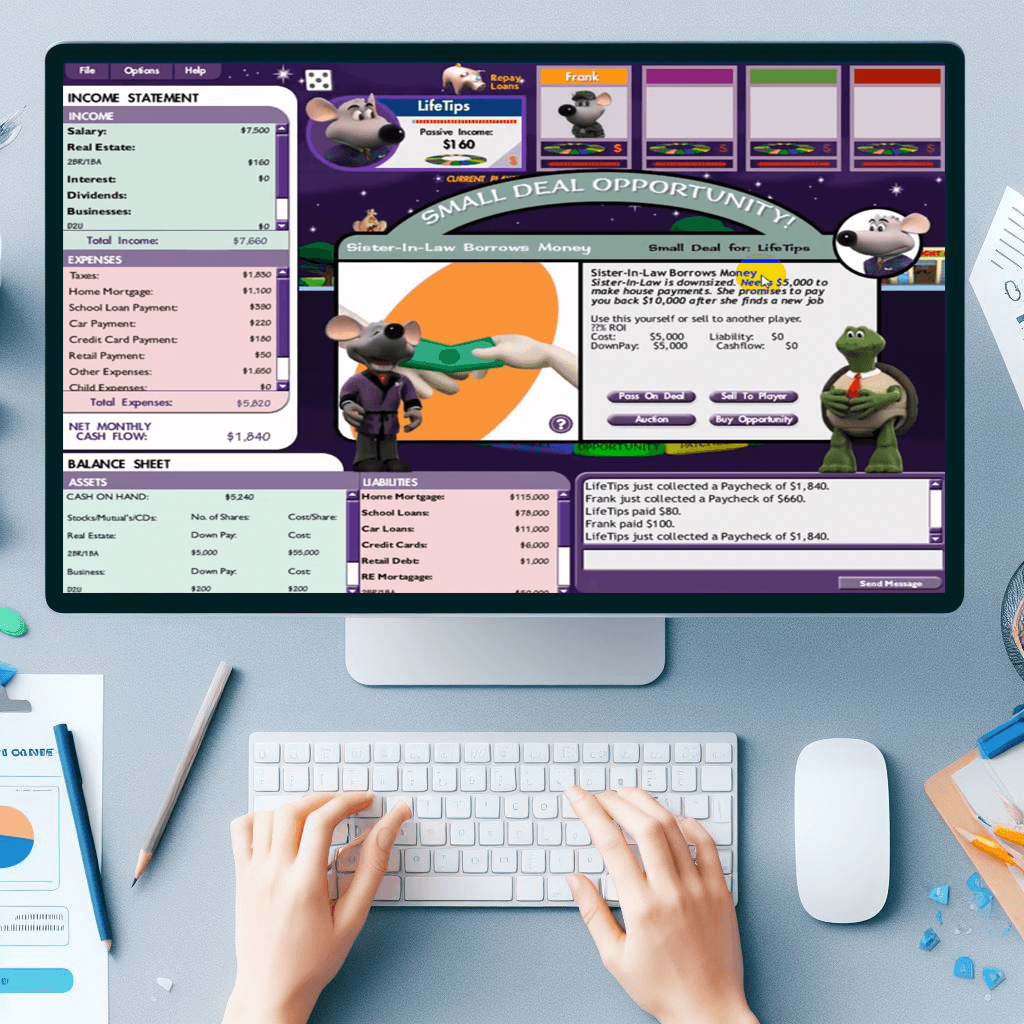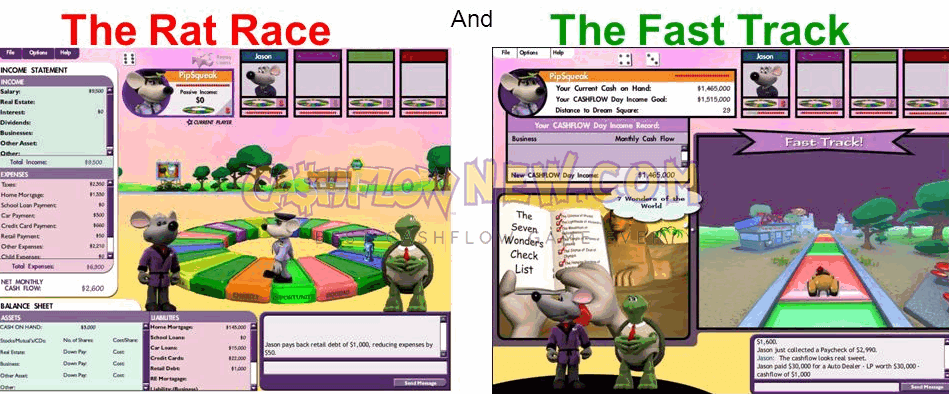
Every CASHFLOW game starts the same way: you have a job, a stack of bills and a rat token stuck on the inner circle. Some players escape in 45 minutes; others are still going around two hours later. The difference is rarely luck. It is a handful of decisions repeated turn after turn. These nine strategies come from the patterns that consistently win games.
1. Calculate your exact escape number on turn one
Look at your profession card and find Total Expenses. That number is your finish line. If your expenses are $2,200, you need more than $2,200 in monthly passive income. Write it at the top of your financial statement. Every deal you consider should be judged by one question: how much of that gap does it close?
Your target moves during the game. A Baby adds a child expense, a bank loan adds interest and a Doodad bought on credit adds a monthly payment. Update the number every time it changes.
2. Prioritize cash flow over price
New players often buy the cheapest property or the most exciting business. Experienced players compare monthly cash flow per dollar of down payment. A $5,000 down payment that adds $200 per month beats a $3,000 down payment that adds $50. If you want a quick way to compare, divide annual cash flow by the down payment to get the cash-on-cash return.
3. Always keep enough cash for a Small Deal
Good deals expire when the next player moves. If you land on an Opportunity space with $400 in cash, you have to pass on deals that might have changed your game. Try to keep at least $2,000 to $5,000 on hand after paying bills. That is enough for most starter houses, condos and low-priced stock offers.
4. Use cheap stocks to fund Big Deals
Stocks in CASHFLOW 101 rarely produce monthly income, but they are the best way to turn a small amount of cash into a large one. When a stock card offers shares at a very low price, buy what you can afford. When a later card offers a much higher price, sell. A few good trades can provide the down payment for an apartment building that adds $1,000 or more per month.
5. Take Charity early
Charity costs 10% of your total income but lets you roll two dice for your next three turns. Two dice move you roughly twice as far, which means you pass more Paychecks and hit more Opportunity spaces. Early in the game, when your income is small, Charity is cheap and the extra movement is very valuable.
6. Pay down the right liabilities
Your expenses include payments on a home mortgage, school loans, a car loan and credit cards. Paying off a liability removes its monthly payment from your expenses and lowers your escape target. Credit card and bank loan payments are often the best candidates because they have the highest payment relative to the balance. Paying off a big mortgage, by contrast, rarely makes sense in the Rat Race.
7. Borrow only when the deal pays for the loan
Bank loans come in $1,000 increments and add 10% of the loan amount to your monthly expenses. Borrowing $2,000 adds $200 per month. That is fine if the deal adds $400 of cash flow, and a disaster if it adds $100. Use leverage only when the numbers clearly work.
8. Sell for capital gains only when you trade up
Market cards offer to buy your properties at a profit. Selling a house that pays $150 per month for a $10,000 gain is smart only if that cash buys something that pays more than $150 per month. Otherwise you have just lowered your passive income. Think of every sale as a step up the ladder, not a cash-out.
9. Avoid Doodads on credit
Doodads are mandatory, but how you pay is up to you. Paying with a credit card turns a one-time cost into a permanent monthly expense, which pushes your finish line further away. Pay in cash whenever you can, even if it delays a deal by a turn.
A sample escape plan
| Phase | Goal | Main moves |
|---|---|---|
| Turns 1–6 | Build a cash cushion | Take Charity, buy only clearly profitable Small Deals |
| Turns 7–15 | Stack passive income | Buy rental property, trade cheap stock for profit |
| Turns 16+ | Close the gap | Use profits for Big Deals, pay off costly liabilities |
What this teaches about real life
The Rat Race is a picture of living paycheck to paycheck. The way out in the game is the same as in life: know what it costs you to live, keep that number low, and buy assets that pay you every month. The game simply lets you practice the decisions dozens of times without real risk.
FAQ
What is the fastest way to get out of the Rat Race in CASHFLOW?
Combine low expenses with steady cash-flowing purchases, use cheap stock trades to fund Big Deals, and take Charity early to roll two dice. Players who follow this plan often escape in under an hour on the e-game.
Does paying off debt help you escape the Rat Race?
Yes. Paying off a liability removes its monthly payment from your total expenses, which lowers the passive income you need. Focus on liabilities with high payments relative to their balance.
Do stocks count as passive income in CASHFLOW 101?
Most stock cards do not pay monthly income; they are bought and sold for capital gains. Use them to raise cash for real estate and businesses that do produce passive income.
Play CASHFLOW 101 & 202 on your PC
Get the Windows e-game edition with a step-by-step installation tutorial and video lessons, so you can practice these strategies tonight.
Related: CASHFLOW 101 & 202 complete rules · Teacher gameplay walkthrough